0DTE Intraday IV Crush and Futures Scalping
Capitalize on intraday IV crush in 0DTE options for futures scalping opportunities. Discover how volatility compression creates highly predictable futures patterns.
Intraday IV Crush
Exploit the daily volatility compression to predict futures momentum.
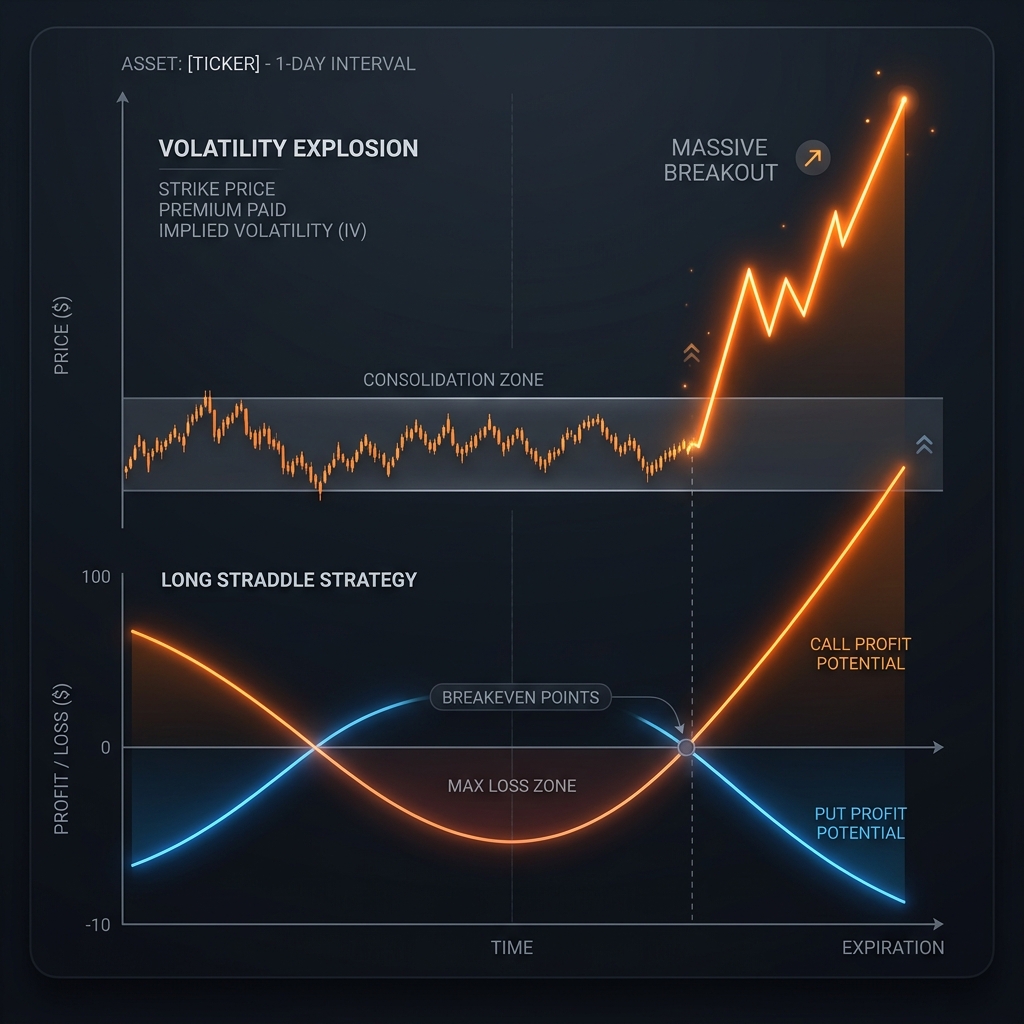
The Phenomenon of Intraday IV Crush
To trade futures effectively alongside the 0DTE options market, you must deeply understand the concept of Intraday Implied Volatility (IV) Crush. While long-term options traders are familiar with IV crush occurring immediately after earnings announcements, 0DTE traders experience a micro-version of this phenomenon every single day.
Implied volatility in 0DTE options is almost always at its absolute peak during the first 30 minutes of the trading session (9:30 AM to 10:00 AM EST). This is because the market is absorbing overnight news, European session sentiment, and initial institutional order flows. Uncertainty is highest, and therefore, option premiums are massively inflated to price in this risk.
As the day progresses and the trading range begins to establish itself, this uncertainty dissipates. Even if the market trends aggressively in one direction, the unknown factors of the day are resolved hour by hour. This leads to a systematic, mechanical compression of implied volatility—the Intraday IV Crush.
For a futures scalper, this compression is not just a secondary metric; it is a primary catalyst that creates highly predictable price action patterns on the ES (E-mini S&P 500) and NQ (E-mini Nasdaq 100).
The Anatomy of the Trading Day
Understanding how IV crush impacts futures price action requires breaking the trading session into four distinct temporal phases. Each phase demands a different scalping approach.
Phase 1: The Volatility Peak (9:30 AM - 10:00 AM EST)
- The Environment: IV is severely elevated. Options makers are pricing in maximum uncertainty. Bid/ask spreads on 0DTE contracts can be wide.
- Futures Price Action: Choppy, erratic, and characterized by wide, sweeping wicks on the 1-minute and 5-minute charts. The market will frequently fake out breakout traders in both directions.
- Scalping Strategy: Capital Preservation. Most professional scalpers sit on their hands during the first 15-30 minutes. The risk of being stopped out by algorithmic liquidity grabs is too high. If you must trade, reduce your position size (e.g., trade MES instead of ES) and widen your stops proportionately.
Phase 2: The IV Compression (10:00 AM - 11:30 AM EST)
- The Environment: The initial panic subsides. IV begins its steepest decline of the day. Options premiums start to deflate rapidly as theta decay and IV crush work in tandem.
- Futures Price Action: This is the most lucrative window for directional scalping. As IV crushes, the “chop” smooths out. If a fundamental trend for the day is going to establish itself, it happens here.
- Scalping Strategy: Trend Following. Identify the dominant momentum established after the 10:00 AM economic data releases. Wait for micro-pullbacks (flags or VWAP bounces) and enter in the direction of the trend. The IV crush provides a “tailwind,” making the price action cleaner and less likely to trigger erratic stop-outs.
Phase 3: The Theta Sinkhole (11:30 AM - 2:00 PM EST)
- The Environment: The lunch hour. IV has largely bottomed out and is sitting at a low baseline. Theta (time decay) is now the dominant force eroding 0DTE option values.
- Futures Price Action: Volume dries up significantly. The market transitions from trending to range-bound consolidation. Price action becomes heavily mean-reverting.
- Scalping Strategy: Mean Reversion / Fade the Extremes. Stop trying to catch massive breakouts. Instead, identify the established high and low of the session. Scalp short from the top of the range and long from the bottom. Target small, consistent gains (3-5 points on ES).
Phase 4: The Gamma Squeeze / Final Settlement (2:00 PM - 4:00 PM EST)
- The Environment: IV may experience a sudden secondary spike if the market nears a major strike price with massive open interest. Theta decay is exponential in the final hour.
- Futures Price Action: Highly volatile and heavily influenced by 0DTE options hedging (Gamma). If dealers are forced to buy or sell futures to hedge their option exposure, the market can experience violent, unidirectional rips.
- Scalping Strategy: Breakout / Momentum. Revert to the Phase 2 strategy, but with tighter timeframes. Be prepared for rapid trend reversals if the market hits a heavy options resistance wall. All scalping positions should be flat by 3:45 PM to avoid the chaotic closing auction.
Exploiting the IV Crush for Scalp Entries
How exactly does a futures trader use options IV to time a scalp? By monitoring the VIX (Volatility Index) or, more accurately, the VIX1D (1-Day Volatility Index) alongside the futures chart.
- The Divergence Play: If ES futures are grinding higher, but the VIX1D is not crushing (meaning options makers are keeping premiums high despite a rally), it signals institutional skepticism. The rally is likely a trap. A scalper should prepare to fade (short) the rally at the first sign of structural weakness.
- The Confirmation Play: If ES is breaking out of a morning consolidation range, and the VIX1D simultaneously drops sharply, this is the ultimate confirmation. The IV crush signifies that market makers are removing the “fear premium,” clearing the path for the futures price to run. This is a high-probability long scalp entry.
- The IV Floor: During Phase 3 (lunch hour), when IV hits a hard floor and stops dropping, it usually means the market has found its equilibrium for the day. This tells the scalper to immediately switch off their trend-following algorithms and start playing mean-reversion tactics.
Execution Rules for IV-Assisted Scalping
Scalping ES or NQ futures based on 0DTE volatility requires intense discipline. The margin for error is razor-thin.
1. Strict Reward-to-Risk Ratios
Never take a scalp where the potential loss exceeds the potential gain. Aim for a minimum 2:1 or 3:1 ratio. On the ES, if you are risking 2 points ($100 per contract), your minimum target must be 4 to 6 points ($200 to $300).
2. The 3-Trade Limit
Overtrading is the death of the scalper. The IV crush provides a limited window of pristine setups (usually between 10:00 AM and 11:30 AM). Limit yourself to 2 or 3 high-quality setups per day. If you catch a solid 10-point move on the ES in the morning, close your terminal and enjoy the day.
3. Stop-Loss Discipline
When scalping, your stop loss is not a suggestion; it is a mathematical necessity. If you enter a trade based on a VIX1D crush confirmation, and the futures price violently reverses against you, the premise of the trade is instantly invalidated. Take the 2-point loss immediately. Do not hold a scalp and turn it into a “swing trade” out of hope.
4. Understand the NQ vs. ES Dynamic
The NQ (Nasdaq) is significantly more volatile and responsive to 0DTE gamma squeezes than the ES. When IV crushes, the NQ will often travel 2 to 3 times the distance of the ES. However, the NQ is also notorious for 10-point stop-hunting wicks. If you are new to this strategy, strictly trade the ES (or MES) until you can read the IV compression patterns flawlessly.
Conclusion: Trading the Market’s Breathing Pattern
Intraday IV crush is essentially the market exhaling after the frantic intake of breath at the morning bell. By aligning your futures scalping strategy with this daily volatility cycle, you stop fighting the algorithmic currents and start riding them. You transition from guessing the next 5-minute candle to mathematically exploiting the structural deflation of risk premium.
The Institutional Edge: Decoding Market Maker Positioning
Retail traders often focus exclusively on price charts, technical indicators, and moving averages. However, in the realm of 0DTE options, price action is merely a symptom of a much larger underlying structure: Dealer Positioning.
Institutional options dealers (market makers) are obligated to take the other side of your trades. When you buy a call, they are short that call. To remain delta-neutral and protect their massive portfolios, these dealers must constantly buy and sell the underlying futures (ES or NQ) to hedge their options exposure.
Understanding Gamma Squeezes
When market makers are caught with “negative gamma” (meaning they are short options that are rapidly moving into the money), they are forced to buy the underlying futures as the market rises, or sell as it falls. This forced buying/selling accelerates the trend, creating a Gamma Squeeze.
Negative Gamma Regimes
In these environments, dealer hedging accelerates market moves. Volatility expands, intraday swings become violent, and momentum strategies (like buying breakouts) thrive.
Positive Gamma Regimes
In these environments, dealers trade against the trend (buying dips, selling rips) to stay neutral. Volatility compresses, the market chops sideways, and mean-reversion strategies thrive.
Advanced Risk Management for Index Futures
Trading 0DTE options on index futures is inherently leveraged. Without a strict, mathematically defined risk management framework, an account can be liquidated in a single afternoon.
The 1% Rule
The foundational rule of professional intraday trading is the 1% rule. Never risk more than 1% of your total account equity on a single 0DTE trade setup. If you have a $10,000 account, your maximum acceptable loss per trade is $100.
Defining Risk in 0DTE
If you are buying premium (long calls/puts), your risk is naturally defined by the premium paid. However, if you are selling premium (credit spreads), your risk is the width of the spread minus the credit received. Always calculate your absolute max loss before clicking the buy button.
Sequential Stop Losses
Professionals do not use static stop losses on 0DTE options because the premium fluctuates too wildly due to Gamma and Vega expansion. Instead, they use structural stops based on the underlying futures price. If ES breaks a critical support level, the option is immediately liquidated, regardless of its current P&L percentage.
The Psychology of Intraday Leverage
The primary reason traders fail in the 0DTE futures space is not a lack of technical knowledge; it is a breakdown in psychological discipline.
The Dopamine Trap
0DTE options provide immediate feedback. Within 15 minutes, you can be up 50% or down 50%. This creates a dopamine feedback loop identical to casino gambling. When a trader hits a massive 300% winner, their brain rewires itself to seek that exact high again, leading to over-leveraging and abandoning proven strategies.
Revenge Trading
After a sharp loss, the instinct is to immediately double the position size on the next trade to “make it back.” This is the fastest way to blow an account.
Fear of Missing Out (FOMO)
Watching the market trend 50 points without you causes immense psychological pain. Entering a trade late simply because it is moving usually results in buying the exact top.
To further refine your strategy, consider comparing this approach with the 0DTE Delta Hedging Strategies for Futures or exploring the mechanics behind 0DTE Breadth Indicators and Futures Direction. Everything ties back into the foundational concepts available in our 0DTE for Futures Hub.
Rather than guessing the market direction, you can use the 01DTE dashboard to see exactly where market makers are hedged.
Ready to Master Intraday IV Crush and Futures Scalping?
Stop guessing and start executing with precision. Join our community of professional traders and get access to real-time gamma levels, flow analysis, and institutional-grade trading tools.
Start Trading NowDisclaimer: This content is for educational purposes only. Not financial advice. Options trading involves substantial risk. Consult a licensed financial advisor before trading. Full disclaimer
Related Articles
0DTE Straddle Strategy
Master the 0DTE straddle for volatility plays and breakout trading. Learn the difference between [strangle](/strategies/0dte-strangle/) and straddle strategy, and when to deploy them.
0DTE Credit Spread Strategy
Master the 0DTE credit spread strategy for consistent daily income. Learn exact entry rules, advanced risk management, and optimal market conditions for zero-day credit spreads.
0DTE Butterfly Spread
Learn the 0DTE butterfly spread — a low-cost, defined-risk strategy that profits from low volatility and precise price targeting.
Bookmap Alternative for 0DTE Futures
Best Bookmap alternatives for 0DTE futures trading. Compare features, pricing, and usability of leading order flow visualization tools.
0DTE Dashboard Tools Compared
Compare the best 0DTE dashboard tools for real-time market analysis. GEX, max pain, IV, and flow analysis tools head-to-head.
About the Author
Raheel Nawaz
Subject Matter ExpertOptions trader and educator specializing in 0DTE strategies with over a decade of experience in short-dated options and futures markets.