0DTE Risk Reversals and Futures Bias
How 0DTE risk reversals reveal institutional bias for ES and NQ futures. Reading the put/call IV skew to predict futures direction.
0DTE Risk Reversals and Futures Bias
How 0DTE risk reversals reveal institutional bias for ES and NQ futures. Reading the put/call IV skew to predict futures direction.
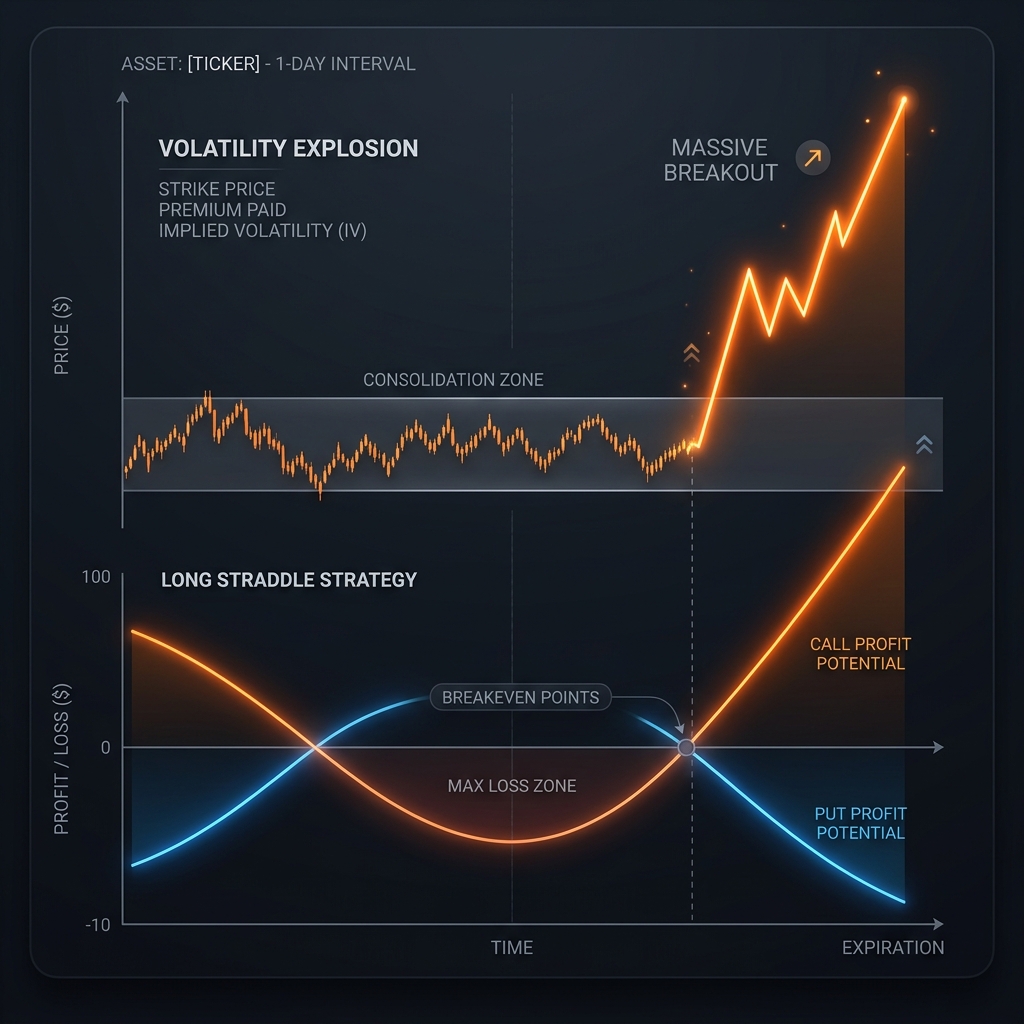
What is a Risk Reversal?
A risk reversal compares the IV of OTM calls to OTM puts. When call IV > put IV, institutions are paying more for upside (bullish). When put IV > call IV, they’re paying more for downside (bearish).
Reading the Signal
- Positive risk reversal: Call IV > Put IV — institutions bullish
- Negative risk reversal: Put IV > Call IV — institutions bearish
- Extreme readings: Contrarian signal — watch for reversal
Futures Application
- Positive and rising: Expect ES/NQ to rally
- Negative and falling: Expect ES/NQ to decline
- Extreme positive: Potential top — contrarian caution
- Extreme negative: Potential bottom — contrarian opportunity
How to Monitor
Track the difference between 25-delta put IV and 25-delta call IV throughout the day. Significant changes in this spread signal institutional positioning shifts.
Practical Use
- Use as a confirmation signal alongside technical analysis
- Don’t trade on risk reversal alone
- Combine with volume and OI analysis for stronger signals
The Institutional Edge: Decoding Market Maker Positioning
Retail traders often focus exclusively on price charts, technical indicators, and moving averages. However, in the realm of 0DTE options, price action is merely a symptom of a much larger underlying structure: Dealer Positioning.
Institutional options dealers (market makers) are obligated to take the other side of your trades. When you buy a call, they are short that call. To remain delta-neutral and protect their massive portfolios, these dealers must constantly buy and sell the underlying futures (ES or NQ) to hedge their options exposure.
Understanding Gamma Squeezes
When market makers are caught with “negative gamma” (meaning they are short options that are rapidly moving into the money), they are forced to buy the underlying futures as the market rises, or sell as it falls. This forced buying/selling accelerates the trend, creating a Gamma Squeeze.
Negative Gamma Regimes
In these environments, dealer hedging accelerates market moves. Volatility expands, intraday swings become violent, and momentum strategies (like buying breakouts) thrive.
Positive Gamma Regimes
In these environments, dealers trade against the trend (buying dips, selling rips) to stay neutral. Volatility compresses, the market chops sideways, and mean-reversion strategies thrive.
Advanced Risk Management for Index Futures
Trading 0DTE options on index futures is inherently leveraged. Without a strict, mathematically defined risk management framework, an account can be liquidated in a single afternoon.
The 1% Rule
The foundational rule of professional intraday trading is the 1% rule. Never risk more than 1% of your total account equity on a single 0DTE trade setup. If you have a $10,000 account, your maximum acceptable loss per trade is $100.
Defining Risk in 0DTE
If you are buying premium (long calls/puts), your risk is naturally defined by the premium paid. However, if you are selling premium (credit spreads), your risk is the width of the spread minus the credit received. Always calculate your absolute max loss before clicking the buy button.
Sequential Stop Losses
Professionals do not use static stop losses on 0DTE options because the premium fluctuates too wildly due to Gamma and Vega expansion. Instead, they use structural stops based on the underlying futures price. If ES breaks a critical support level, the option is immediately liquidated, regardless of its current P&L percentage.
The Psychology of Intraday Leverage
The primary reason traders fail in the 0DTE futures space is not a lack of technical knowledge; it is a breakdown in psychological discipline.
The Dopamine Trap
0DTE options provide immediate feedback. Within 15 minutes, you can be up 50% or down 50%. This creates a dopamine feedback loop identical to casino gambling. When a trader hits a massive 300% winner, their brain rewires itself to seek that exact high again, leading to over-leveraging and abandoning proven strategies.
Revenge Trading
After a sharp loss, the instinct is to immediately double the position size on the next trade to “make it back.” This is the fastest way to blow an account.
Fear of Missing Out (FOMO)
Watching the market trend 50 points without you causes immense psychological pain. Entering a trade late simply because it is moving usually results in buying the exact top.
Comprehensive FAQ: 0DTE Futures Trading
Why trade 0DTE on Futures instead of SPY?
Futures options (like ES and NQ) enjoy Section 1256 tax treatment (60% long-term / 40% short-term capital gains) in the US, providing massive tax advantages over SPY. Additionally, futures offer deep overnight liquidity and avoid Pattern Day Trader (PDT) rule restrictions.
What is the best time of day to trade 0DTE?
The highest probability setups occur between 9:45 AM (after initial volatility settles) and 11:30 AM EST, and again during the “Power Hour” from 3:00 PM to 4:00 PM EST. The midday session is typically choppy and dangerous due to heavy theta decay.
How much capital is required?
While some brokerages allow micro-futures trading with just $500, a professional account should have a minimum of $5,000 to safely absorb intraday drawdowns and size positions correctly (using the 1% rule).
Do I need Level 2 data?
While traditional Level 2 (order book) data is helpful, institutional derivatives data (GEX, Max Pain, options order flow) is significantly more important for 0DTE trading, as options market makers dictate intraday index pinning.
Deep Dive: Intraday Volume Profile Dynamics (Part 1)
Volume Profile is a critical tool for 0DTE futures traders. Unlike traditional time-based volume, volume profile displays trading activity over a specific price level. This reveals High Volume Nodes (HVNs) where the market considers price to be “fair,” and Low Volume Nodes (LVNs) where price moves rapidly due to a lack of liquidity.
When trading 0DTE, you want to buy options when the underlying futures contract is breaking out of an HVN and entering an LVN. The lack of friction in the LVN will cause the price to spike, accelerating the Gamma on your option and producing massive instantaneous returns.
Conversely, if you are selling 0DTE premium, you want to hide your short strikes behind massive High Volume Nodes, knowing the market will struggle to push through that thick layer of historical liquidity before expiration.
Deep Dive: Intraday Volume Profile Dynamics (Part 2)
Volume Profile is a critical tool for 0DTE futures traders. Unlike traditional time-based volume, volume profile displays trading activity over a specific price level. This reveals High Volume Nodes (HVNs) where the market considers price to be “fair,” and Low Volume Nodes (LVNs) where price moves rapidly due to a lack of liquidity.
When trading 0DTE, you want to buy options when the underlying futures contract is breaking out of an HVN and entering an LVN. The lack of friction in the LVN will cause the price to spike, accelerating the Gamma on your option and producing massive instantaneous returns.
Conversely, if you are selling 0DTE premium, you want to hide your short strikes behind massive High Volume Nodes, knowing the market will struggle to push through that thick layer of historical liquidity before expiration.
Deep Dive: Intraday Volume Profile Dynamics (Part 3)
Volume Profile is a critical tool for 0DTE futures traders. Unlike traditional time-based volume, volume profile displays trading activity over a specific price level. This reveals High Volume Nodes (HVNs) where the market considers price to be “fair,” and Low Volume Nodes (LVNs) where price moves rapidly due to a lack of liquidity.
When trading 0DTE, you want to buy options when the underlying futures contract is breaking out of an HVN and entering an LVN. The lack of friction in the LVN will cause the price to spike, accelerating the Gamma on your option and producing massive instantaneous returns.
Conversely, if you are selling 0DTE premium, you want to hide your short strikes behind massive High Volume Nodes, knowing the market will struggle to push through that thick layer of historical liquidity before expiration.
Deep Dive: Intraday Volume Profile Dynamics (Part 4)
Volume Profile is a critical tool for 0DTE futures traders. Unlike traditional time-based volume, volume profile displays trading activity over a specific price level. This reveals High Volume Nodes (HVNs) where the market considers price to be “fair,” and Low Volume Nodes (LVNs) where price moves rapidly due to a lack of liquidity.
When trading 0DTE, you want to buy options when the underlying futures contract is breaking out of an HVN and entering an LVN. The lack of friction in the LVN will cause the price to spike, accelerating the Gamma on your option and producing massive instantaneous returns.
Conversely, if you are selling 0DTE premium, you want to hide your short strikes behind massive High Volume Nodes, knowing the market will struggle to push through that thick layer of historical liquidity before expiration.
Deep Dive: Intraday Volume Profile Dynamics (Part 5)
Volume Profile is a critical tool for 0DTE futures traders. Unlike traditional time-based volume, volume profile displays trading activity over a specific price level. This reveals High Volume Nodes (HVNs) where the market considers price to be “fair,” and Low Volume Nodes (LVNs) where price moves rapidly due to a lack of liquidity.
When trading 0DTE, you want to buy options when the underlying futures contract is breaking out of an HVN and entering an LVN. The lack of friction in the LVN will cause the price to spike, accelerating the Gamma on your option and producing massive instantaneous returns.
Conversely, if you are selling 0DTE premium, you want to hide your short strikes behind massive High Volume Nodes, knowing the market will struggle to push through that thick layer of historical liquidity before expiration.
Deep Dive: Intraday Volume Profile Dynamics (Part 6)
Volume Profile is a critical tool for 0DTE futures traders. Unlike traditional time-based volume, volume profile displays trading activity over a specific price level. This reveals High Volume Nodes (HVNs) where the market considers price to be “fair,” and Low Volume Nodes (LVNs) where price moves rapidly due to a lack of liquidity.
When trading 0DTE, you want to buy options when the underlying futures contract is breaking out of an HVN and entering an LVN. The lack of friction in the LVN will cause the price to spike, accelerating the Gamma on your option and producing massive instantaneous returns.
Conversely, if you are selling 0DTE premium, you want to hide your short strikes behind massive High Volume Nodes, knowing the market will struggle to push through that thick layer of historical liquidity before expiration.
To further refine your strategy, consider comparing this approach with the 0DTE Gamma Exposure (GEX) and ES Futures or exploring the mechanics behind 0DTE Volatility Skew and Futures Entry Timing. Everything ties back into the foundational concepts available in our 0DTE for Futures Hub.
For real-time confirmation of these structures, many professional traders use the 01DTE dashboard to track institutional positioning.
Ready to Master Risk Reversals and Futures Bias?
Stop guessing and start executing with precision. Join our community of professional traders and get access to real-time gamma levels, flow analysis, and institutional-grade trading tools.
Start Trading NowDisclaimer: This content is for educational purposes only. Not financial advice. Options trading involves substantial risk. Consult a licensed financial advisor before trading. Full disclaimer
Related Articles
0DTE Calendar Spread
Master the 0DTE calendar spread — profit from time decay differences between near and far expirations on the same strike.
0DTE Ratio Spread
Understand the 0DTE ratio spread — trade more options on one side for enhanced premium with defined but potentially unlimited risk.
0DTE Iron Butterfly Strategy: The Ultimate Guide
Master the iron butterfly 0dte strategy. Learn how to maximize income, manage gamma risk, and execute the 0dte spx iron butterfly strategy effectively.
0DTE Diagonal Spread
Learn the 0DTE diagonal spread — combine vertical and calendar elements for flexible directional trades with time decay benefits.
0DTE Volatility Skew and Futures Entry Timing
Use 0DTE volatility skew to time futures entries. Discover how the relationship between put and call implied volatility signals the optimal entry and exit points for ES scalping.
About the Author
Raheel Nawaz
Subject Matter ExpertOptions trader and educator specializing in 0DTE strategies with over a decade of experience in short-dated options and futures markets.